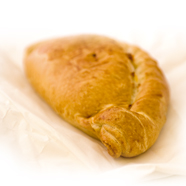
"Would flaky pastry have survived the drop of a mine shaft? We think not."
|
|
|
5 minute guide to... The Cornish pasty
Who'd have thought a simple wrapping of pastry around meat and veg could invoke the pride, passion and arguments that surround the good ol' oggy. Stef Fox pokes around under the crust of the Cornish pasty.
In the beginning…
The oldest written pasty recipe dates from 1746, but some say pasties were eaten in Cornwall way before that. Cave paintings found on The Lizard show a filling wrapped in leaves (though no paper bag) being eaten around 8,000 years ago.
It was the tin mining industry that led to the pasty in its far tastier current form. Pastry protected the filling during cooking and transportation, and it was said that a good pasty should be strong enough to be dropped down a mineshaft. The pasty's heat kept the miner warm 'til he ate, by holding the crust with his dirty hands, then throwing it away.
Fillings depended on what was available, and anything from mackerel to rabbit and even rice found itself wrapped in a crust, but beef, potato, swede (or turnip?) and sometimes onion became known as the traditional Cornish pasty filling. There were other versions of course; sweet 'windy pasties' were made from leftover pastry and jam, and anecdotal evidence suggests the existence of a two-course pasty, with meat at one end and fruit at the other. Penryn is also known for making a boiled pasty.
When the tin industry faltered, Cornish miners emigrated and took their favourite lunch with them. There are now versions of the pasty around the world, and they're particularly popular in
South America, Australia and the USA - though none are as good as the original, of course.
Heated debates
They've been around so long you'd think the characteristics of the Cornish pasty would be well established - not so.
Devon or Cornwall? When Devon tried to claim the pasty as its own in November last year, thanks to the discovery of a reference to pasty-making in a document dating from 1510, Cornwall nearly took up arms. But the cave paintings, literary references and anecdotal evidence suggest that the pasty is Kernow to the crust.
Verdict: Could we say anything but Cornwall? Side or top crimp? It's said that the side crimp must be the traditional Cornish way as it was used as a handle by miners, but others say that a top crimp - considered Devonian by many - that extended to the sides would have served the same purpose. Les Merton, author of the tongue-in-cheek The Official Encyclopedia of the Cornish Pasty (Palores Publications, £4.95) says the side crimp is more traditionally Cornish. "But you do find top crimps as you get closer to Devon," he says. "And you can sex a pasty by its side crimp; to the right it's a hen, left is a cock."
Verdict: The sides have it.
Flakey or shortcrust? Quite simple, this one - would flaky pastry have survived the drop of a mine shaft? We think not.
Verdict: Shortcrust.
Swede or turnip? Pasty expert Phil Ugalde from Proper Cornish sheds light on this: "When it comes to the traditional Cornish pasty, swede and turnip are one and the same vegetable. If you were to have asked an old Cornish housewife what she put into her pasties she would say 'beef, potato, onion and turnip'- but she would show you a swede."
Verdict: Ja! The swede, for sure.
Myths and legends
Such was the importance of the pasty to Cornwall that folklore surrounds it. It was said that, as Cornish housewives were known to put anything in the pasty, the devil wouldn't come to the county for fear of ending up as a filling. Other evil characters were more keen on the oggy: miners left their discarded crusts to appease the knockers - mischievous spirits who might otherwise lead them into danger; and to this day fishermen consider it bad luck to take pasties to sea.
Purchasing your pasty
Choose your pasty carefully - there are many pretenders out there. Those from Proper Cornish certainly fit the bill, as they're hand-made from local ingredients and with a variety of traditional fillings such as steak, or lamb and mint, to the more unusual turkey and stuffing. Hampsons, has two shops in Hayle, and a great local following because all its meat is sourced locally and put into hand-made pasties that can be made to order - we like the pork. Pengenna Pasties is also a favourite across Cornwall - though its pasties have the controversial top crimp - and can be found in St Ives, Bude and Tintagel, though you can order from the Bude shop and have them delivered to your door.
This feature was first published in the Mar-Apr 07 issue of Cornwall food magazine.
|